


































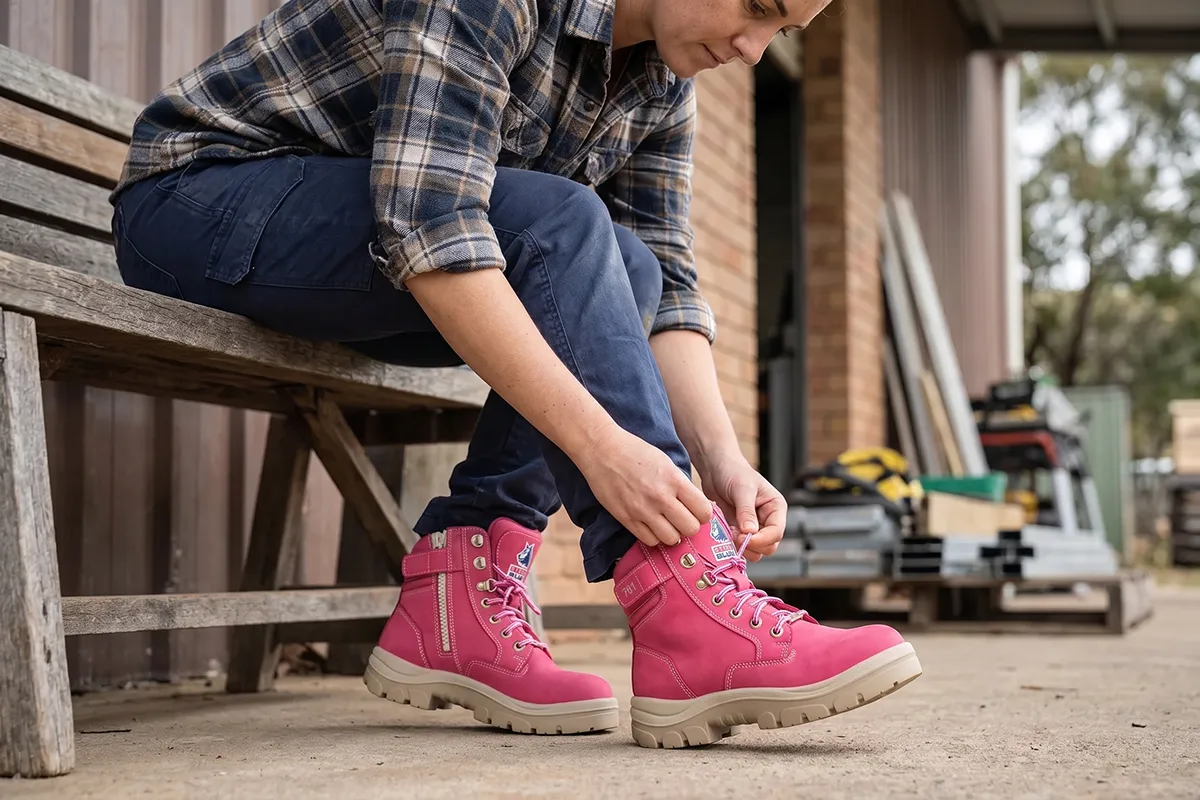
Women’s Work Boot Sizing: How to Get the Right Fit
Getting women’s work boot sizing right starts with more than knowing your usual shoe size. The brand, boot shape, sizing system and socks you wear can all affect the fit.
Start by measuring both feet, checking the size guide for your chosen model and trying on both boots with your normal work socks. Your toes need room, your heel should feel secure, and there should be no painful pressure points.
Whether you’re buying your first safety boots or replacing a worn-out pair, this guide will help you work out what to check before you order.
Table of Contents
Women’s work boot sizing: where to start
Before selecting a size, check these three things on the product listing:
- Sizing system: Is the size shown in AU, UK, US or EU?
- Fit: Is the boot specifically designed for women or offered in a unisex fit?
- Model guidance: Does the manufacturer provide a separate chart or fitting advice for that range?
A size number without its sizing system is only part of the information you need. Avoid assuming that the size you wear in trainers will be the right selection in every work boot.
Start with the Safety 1st size guide. If you’re unsure which chart applies, ask before ordering.
Still deciding which boot suits your work? Our best women’s work boots NZ comparison helps you compare the options.
How to measure your feet for work boots
You’ll need a sheet of paper, a pencil and a ruler or tape measure.
- Check the manufacturer’s measuring instructions. Follow its guidance on whether to measure barefoot or wearing socks. Blundstone’s NZ guide, for example, specifies bare feet.
- Place the paper on a firm, level floor. Stand with your weight distributed naturally.
- Mark your heel and longest toe. Keep the pencil upright so you don’t add extra length by angling it.
- Measure between those marks in millimetres.
- Repeat for the other foot. Use the longer measurement when checking the appropriate size chart.
Blundstone recommends measuring both feet and using the larger measurement to choose your starting size. A measurement helps narrow your options, but trying on the boots still matters. www.blundstone.co.nz
Record your measurements rather than relying on memory. When asking for sizing help, include the exact boot model and the size and brand you currently wear.
Women’s work boot sizing fit versus unisex work boots
A women’s work boot can differ in shape as well as size.
The mould used to shape footwear is called a last. Steel Blue, for example, uses a women’s last for its women’s range. Its women’s designs include a smaller instep and shorter ankle length. steelblue.com
That doesn’t mean every woman needs the same fit. Some people will prefer a women’s model; others may find a suitable fit in a unisex boot.
The useful question is: does this boot hold your foot comfortably in the right places?
If the length seems right but your heel moves around, or the top of your foot feels squeezed, compare another boot shape before simply changing the size.
Can you convert women’s sizes to men’s sizes?
Use the brand’s conversion chart rather than a universal rule.
Steel Blue advises that women choosing its men’s boots will generally select two Australian sizes below their usual Australian women’s size. That guidance is specific to Steel Blue and the sizing systems it describes. Don’t automatically apply it to another brand or a US size. steelblue.com
How should women’s safety boots fit?
Try both boots later in the day, wearing your usual work socks. Fasten them properly, then walk and bend to assess comfort.
Steel Blue advises checking for rubbing, slipping, painful pressure and toes hitting the protective cap. Its fitting guide suggests approximately one centimetre between the longest toe and the end of the boot. Follow the guidance for your particular model rather than treating one measurement as universal. steelblue.com
Use these questions during your fitting:
| Area | What to check |
|---|---|
| Toes | Can you move them comfortably without contact or pressure from the cap? |
| Forefoot | Is there room across the widest part of your foot? |
| Heel | Does it feel secure without persistent rubbing or excessive movement? |
| Instep | Does the boot hold the top of your foot without squeezing it? |
| Movement | Can you walk and bend comfortably with the boots fastened? |
Notice where the fit feels wrong. “Too tight across the forefoot” is more useful information than “this size doesn’t fit” when comparing alternatives.
Should you size up for thicker socks?
Try the boots with the socks you actually intend to wear before deciding to size up.
A boot that feels comfortable with thin socks may feel different with thick winter work socks. Blundstone recommends wearing your intended socks when trying on boots and bringing your usual orthotics if you use them. Blundstone
If your work involves different conditions throughout the year, bring both your everyday socks and your thicker pair to the fitting.
Tell the retailer if you plan to use a replacement footbed or orthotic. Ask whether it is suitable for the boot and how it should be fitted, rather than adding layers until the boot feels tight.
What if you’re between sizes?
First, work out whether the issue is length, width or overall shape.
Half sizes don’t always mean extra length. Steel Blue explains that its half sizes provide additional width without changing the boot’s length. Blundstone’s work and safety footwear guide also describes half sizes as a wider fit at the same length. steelblue.com
That makes the distinction useful:
- Toes reaching the front: Ask about a longer size.
- Enough length but tight across the foot: Ask about width options.
- Comfortable toes but a loose heel: Compare the fit of another model.
- Pressure over the top of your foot: Check the fastening adjustment and boot shape.
Avoid ordering a longer boot solely to solve a width problem without checking the alternatives.
Lace-up, zip-up or slip-on: what changes about fit?
Fastening style changes how you adjust the boot and put it on.
| Style | What to consider when trying it on |
|---|---|
| Lace-up | Adjust the laces along the foot and ankle, then check for an even, comfortable hold. |
| Lace-up with side zip | Set the fit with the laces first. The zip provides convenient access but doesn’t replace that adjustment. |
| Elastic-sided slip-on | Pay particular attention to the instep and heel because there are no laces to fine-tune the hold. |
Don’t choose a fastening style on convenience alone. Try the movement you need for your work and compare how each option feels.
For model comparisons, return to our women’s work boots buying guide.
Will tight work boots stretch?
Don’t buy uncomfortable boots on the assumption that they will become the right size.
Leather can soften and mould with wear, but Blundstone explains that its boots will not stretch lengthwise. If your toes reach the end when new, wearing them longer won’t create the missing length. Blundstone
Treat the initial fitting as your opportunity to identify problems. Tell the retailer exactly where you feel pressure and compare another size or model before committing.
Buying women’s work boots online
Before placing your order:
- Confirm the model and sizing system.
- Check your measurements against the applicable size chart.
- Mention any previous problems with width, heel movement or instep pressure.
- Ask about compatibility with orthotics or replacement footbeds.
- Read the returns policy and confirm the conditions for a size exchange.
Check the Safety 1st returns policy before opening or trying on an order. If you’re uncertain about the conditions, contact the team first.
Frequently asked questions
Are women’s work boot sizes the same across brands?
Don’t assume they are. Check both the sizing system and the chart for the exact model. Keep a note of the brand, model and size that fits you now to help compare your options.
Should I buy work boots a size bigger than my usual shoes?
Not automatically. Use the manufacturer’s chart as your starting point, then assess the fit with your normal work socks. A larger number isn’t a reliable shortcut to a more comfortable boot.
What if one foot is bigger than the other?
Use the larger foot’s measurement when consulting the size chart, then check both boots during the fitting. Explain any noticeable difference to the retailer so you can assess the fit on each foot.
Can I wear unisex safety boots?
Yes, provided the particular boot fits you properly and meets your workplace requirements. Compare the heel, instep and forefoot fit rather than choosing solely by the women’s or unisex label.
Need help choosing your size?
Contact Safety 1st with your foot measurements, the model you’re considering and the details of your current boots. Include any fit problems you want to avoid.
Get help choosing your work boots or compare women’s work boots before you order.